


No feeling is permanent. There is a constant oscillation between the positive and negative feelings. Emotions are constantly changing, in part because feelings change, and in part due to the constant stream of ideas that flow in the unconscious mind. At the conscious and subconscious levels of mind we can focus on an unconscious idea and use it to pursue a trend or theme about something that interests us at that moment. Hence we can make an emotion last whilst we follow that trend.
The difference between the flow of ideas at the conscious and subconscious levels is mainly related to the issue of change. The conscious flow is easy to change, especially when we are in social company, but the subconscious flow seems to have a life of its own and is highly resistant to conscious attempts to change it. In social company or if we are idealistic we can give preference to our conscious ideas, and hence control our conscious emotional response. But on our own, without the influence of idealism, the subconscious mind usually exerts priority in emotional response. If the conscious mind is not dominant, that is, if we do not value what we are doing at any particular moment, then the subconscious mind is dominant (and so we may become subject to uncontrollable moods).
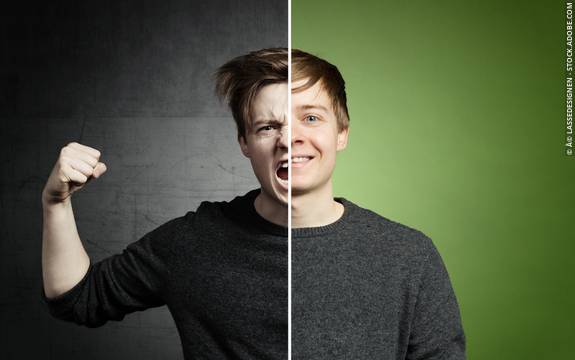
As I show below, emotions can be grouped into complementary pairs. I call these pairs ‘binaries’. A few lines above I used two examples of binary emotions. I paired anger and fear together, and then love and hate together. Another binary is vanity and self-pity. What determines the choice of either emotion in a pair ? For example, what governs a person, at a particular moment, in their selection of either anger or fear as their response to something? The choice is not a random one. The choice revolves around the dominating influence of value.
We put a value on emotional experience. By either liking or disliking things, relationships, situations, etc we put a value on them. At any particular moment we may either like or dislike something ; but this liking and disliking can take many forms. For example, the way that we like that something may lead us to choose between anger, love or vanity as our response. Anger allows us to dominate the situation ; love enables us to harmonise with other people ; vanity lets us feel important. The way that we dislike it may focus on fear, hate or self-pity.
So at any particular moment we are focusing on a trend of thought, with a relevant emotion being experienced. Then there is some change in the situation that needs an emotional response from us. Sometimes we can consciously choose our response, particularly if the situation is a pleasant one. But more often than not we act subconsciously. The value that we place on the situation at that moment determines which emotion will be felt. For example, if we are feeling discontented, we will place little positive value on our present experience ; then when we have to respond to something we are more likely to choose some form of hostile or fearful response.
As well as putting value on our situations, we also put value on our thoughts and ideas. Now an unconscious idea has two values : it is good or it is bad. The good value is supported by the pleasant feeling, the bad value by the unpleasant feeling. This division leads to two choices. One choice gives rise to one emotion, the other choice to its complement. Hence emotions can be grouped into complementary pairs, or binaries.
In general then, if we are free-wheeling in our thoughts, we can let our emotions be positive or negative according to whether the feeling is positive or negative. Otherwise, by placing value on our experience, we can generate positive or negative emotions as we choose. However, the generation of a positive emotion is often difficult if the feeling that is current is the negative one, and vice versa.
The unconscious idea enables all emotions to be arranged in pairs of complementary opposites. The one exception is that the neutral feeling is unique, it is not part of a binary. It is the basis of equanimity, the ability to be unaffected by any kind of stress. Equanimity should not be confused with indifference or even peace ; indifference is a protective mechanism of withdrawal from responsibility and is underpinned by fear, whilst peace is achieved by repressing internal conflict (that is, conflict that is within the mind of a person).
In psychological language, equanimity is the state of mind which denotes the absence of projection and introjection. When a person uses the mechanisms of projection and introjection, they are making value judgements about the characteristics of other people that they admire or dislike. When they cease making such value judgements, they thereby cease to desire anything of a personal nature. [³]
I list some emotions which are binary to each other :
fear - anger
love - hate
jealousy - narcissism
pride - guilt
vanity - self-pity
resentment - bitterness
Some emotions have an additional complexity: they are compound and consist of two simpler emotions. I call such an emotion either a compound emotion or a ‘doublet’, and each of the separate emotions within a doublet I call a ‘mode ’ of that doublet. For example, guilt comprises the two simpler emotions of self-pity and self-hate. So guilt is experienced as guilt (in the mode of self-pity) or as guilt (in the mode of self-hate).
I list some compound emotions and then I give a table of unconscious ideas that determine emotions.
Table 1: Compound Emotions
Guilt = self-pity + self-hate.
Pride = vanity + hatred of other people.Narcissism = love + vanity.
Jealousy = love + self-pity.Resentment = guilt + idealism.
Bitterness = pride + idealismRepentance = regret + guilt (mode of self-pity).
Sadness = regret + jealousy (mode of self-pity).Paranoia = fear + pride (mode of vanity).
Anxiety = fear + vanity.
In the compound emotions of guilt, pride, narcissism, and jealousy, only one mode is felt at any one time – they are never experienced simultaneously. For example, guilt is felt as either self-pity or as self-hate.
How do I know that some emotions are compound ones ? Guilt was the first one that I identified. Once I learned to detect guilt by empirical awareness I became puzzled by the fact that it seemed to exhibit contrary impressions. Then I realised that this difficulty could be explained by postulating that guilt consisted of two factors. It then became an empirical task to see if I could detect these two separate factors – and I did.
Now guilt equals self-pity plus self-hate. This arrangement of the two emotions within guilt has three other possible combinations, by taking the binaries of self-pity and self-hate. So if my factorisation of guilt was correct then three other compound emotions should also exist, with their factors being:
self-pity + love
vanity + love
vanity + hate
Eventually I realised through intuition that these compound emotions represented jealousy, narcissism, and pride. Then again I empirically verified that my theorising was correct. The hallmark of a compound emotion is that it produces ambiguous responses ; the ambiguity always falls into two categories, thus indicating that two factors are present and need to be separated.
For example, in sadness there is sorrow (from the regret) plus a sweetness (from the jealousy). When the jealousy factor is highlighted, then I always find that sadness is a lovely emotion in which I often like to linger, whereas the sorrow element makes sadness unpleasant.
Unconscious Ideas
Now I turn to unconscious ideas. Deriving them was not easy. Some emotions occur three times ; for example, self-pity occurs on its own, as a mode of jealousy, and as a mode of guilt, and each one produces a different response. To work out the underlying idea, the overall theme or motif of the emotion needs to be considered, that is, what the emotion is trying to express. Also, in a doublet, one unconscious idea needs to be harmonious with the other one. Below are the results that I derived.
I use the word ‘implies’ to indicate the central idea that determines a particular emotion. These ideas are focused on relationships. When a relationship is not the issue, then different responses may occur. For example, the vanity mode of pride, when applied to crafts, produces the satisfaction of doing good work.
Table 2 :Unconscious Ideas
- The motif of guilt and pride is punishment / humiliation
Guilt is self-punishment
self-pity mode implies life is punishment.
self-hate mode implies I deserve punishment.
Pride is punishment / humiliation of other people.
vanity mode implies you are inferior to me.
hate mode implies I despise you / I will punish you.
- The motif of jealousy and narcissism is responsibility
Jealousy is social responsibility.
self-pity mode implies I need a reward (from other people).
love mode implies I reward other people.
- Narcissism is self-responsibility.
vanity mode implies I will do it my way.
love mode implies I do not depend on anyone.
- The motif of self-pity and vanity is help
Self-pity implies I need help.
Vanity implies I do not need any help.
- The motif of anger and fear is domination
Anger implies I need to dominate other people
Fear implies the world is dominating me.
- The motif of love and hate is identity
Love implies I am the same as everyone else.
Hate implies I am different from everyone else.
- The motif of envy and greed is the need to acquire importance
Envy implies I become important if I can get what you have.
Greed implies I become important if I possess things.
- The motif of resentment and bitterness is disgust
Resentment implies people are repulsive.
Bitterness implies life is repulsive.
- The motif of paranoia is the betrayal of trust
Paranoia implies I trust no one.
- The motif of anxiety is a sense of oppression by one’s conscience or by other people
fear mode implies do as you are told / control yourself.
vanity mode implies I am uneasy in the presence of other people.
Depression arises from self-pity; there are three forms of the latter, so there are three forms of the former.
The most common type arises from jealousy (mode of self-pity) and is the depressive stage of manic depression. Guilt-based depression (or ‘endogenous’ depression) has its source in the infant’s traumatic experience of parental relationships and represents a response to the feeling of being rejected. Depression that arises from self-pity may be seen in political refugees denied asylum, and in anyone who is a victim of injustice. [4]
- The motif of manic depression is victimisation
depression mode implies I am a victim.
mania mode implies I help victims. - The motif of guilt-based depression is self-denigration
Depression implies I am a sinner.
- The motif of depression based on self-pity is the absence of equity or fairness
Depression implies there is no equity, no fairness in life.
These ideas enable me to state how motivation is usually handled by the subconscious mind.
Subconscious motivation usually means the influence of the current subconscious mood and its associated ideas.
By dwelling on an associated idea, an emotion becomes prolonged into a mood. Since moods change frequently, this form of motivation is short-term. Long-term subconscious motivation requires a subconscious desire, but unless this desire is powered by idealism it is likely to be much weaker as an influence on the ego than any mood.
Copyright © 2002 Ian Heath. All Rights Reserved